SPM 2023 Add Maths Paper 2, Question 13Kinematics of Linear Motion
Solved on video in English and Bahasa Melayu · Form 5, Kinematics of Linear Motion · 8:13 video
The question
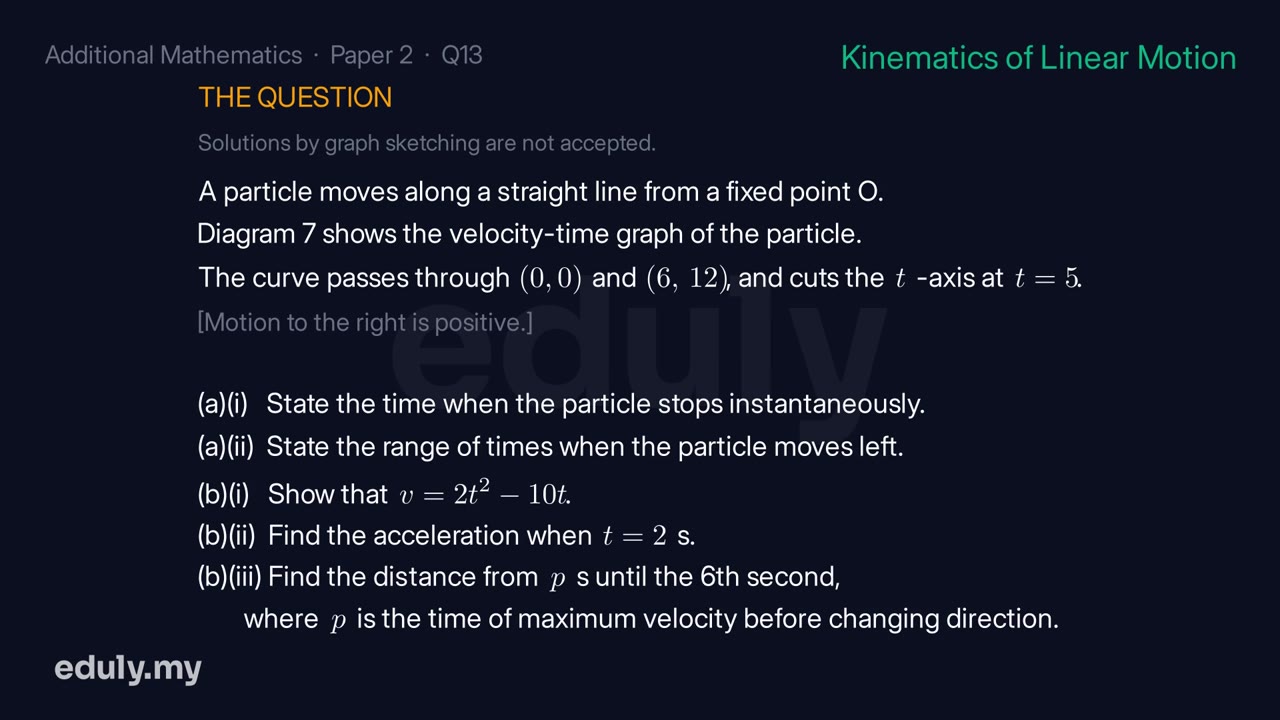
(Solutions by graph sketching are not accepted.) A particle moves along a straight line from a fixed point O. Diagram 7 shows the velocity-time graph of the particle's motion. [Assume motion to the right is positive.]
(a)(i) State the time, in seconds, when the particle stops instantaneously.
A particle moves along a straight line from O; Diagram 7 shows its velocity-time graph (motion to the right is positive).
(a)(ii) State the range of times, in seconds, when the particle moves towards the left.
The velocity-time graph (Diagram 7) passes through the origin and (6, 12), and cuts the t-axis at t = 5. It is given that the velocity-time graph is a quadratic function.
(b)(i) Show that v = 2t² − 10t.
The velocity is v = 2t² − 10t.
(b)(ii) Find the acceleration, in m s^−2, when t = 2 seconds.
The velocity is v = 2t² − 10t.
(b)(iii) Find the distance, in m, travelled by the particle from p seconds until the 6th second, where p is the time when the maximum velocity is achieved before it changes direction.
 8:13
8:13Part (a)(i)
Step 1
The particle stops instantaneously when v = 0 (the graph cuts the t-axis).
1 more step, with the reason for it, in the full solution
Final answer
t = 5 s
Part (a)(ii)
2 more steps, each with the reason for it, in the full solution
Final answer
0 < t < 5
Where students lose marks
Watch out: use strict inequalities. Write 0 < t < 5, not 0 ≤ t ≤ 5, because v = 0 at both ends.
Part (b)(i)
3 more steps, each with the reason for it, in the full solution
Final answer
Shown
Where students lose marks
Watch out: don't just check t = 6 in the given v. Build v from roots 0 and 5, then use (6, 12).
Part (b)(ii)
2 more steps, each with the reason for it, in the full solution
Final answer
a = −2 m s⁻²
Where students lose marks
Watch out: differentiate every term of v. Stopping at 4t gives a = 8 instead of a = −2.
Part (b)(iii)
7 more steps, each with the reason for it, in the full solution
Final answer
p = 5/2 s; distance = 26.5 m
Where students lose marks
Watch out: the particle turns at t = 5. Split there and add the two distances; one net displacement (15.17 m) is wrong.
Watch every step of this question solved on video (8:13), with the reason behind each step and a box that checks your own answer.
No card. Every past-year question on video, in English and BM.
More Kinematics of Linear Motion questions
- SPM 2020 Add Maths Paper 2, Question 12
- SPM 2021 Add Maths Paper 2, Question 12
- SPM 2022 Add Maths Paper 2, Question 15
- SPM 2024 Add Maths Paper 2, Question 14
- Kuala Lumpur Trial 2025 Add Maths Paper 2, Question 15
- Melaka Trial 2025 Add Maths Paper 2, Question 14
- MRSM Trial 2025 Add Maths Paper 2, Question 15
- Selangor Trial 2025 Add Maths Paper 2, Question 12
Questions are re-typeset by Eduly for study and commentary. Eduly is not affiliated with Lembaga Peperiksaan Malaysia or the Ministry of Education.