Kuala Lumpur Trial 2025 Add Maths Paper 2, Question 15Kinematics of Linear Motion
Solved on video in English · Form 5, Kinematics of Linear Motion · 7:31 video
The question
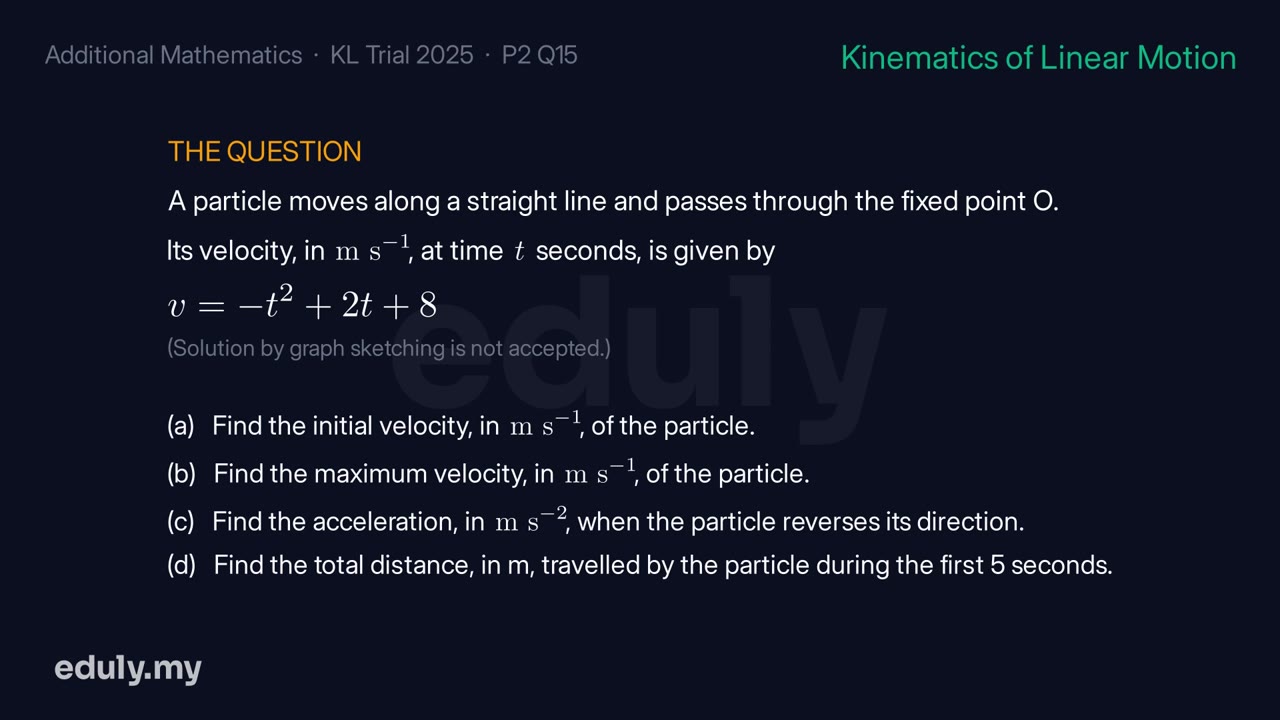
(Solution by graph sketching is not accepted.) A particle moves along a straight line such that its velocity v ms⁻¹ is given by v = −t² + 2t + 8, where t is the time in seconds after passing through the fixed point O.
(a) Calculate the initial velocity, in ms⁻¹, of the particle.
A particle moves along a straight line such that its velocity v ms⁻¹ is given by v = −t² + 2t + 8, where t is the time in seconds after passing through the fixed point O.
(b) Calculate the maximum velocity, in ms⁻¹, of the particle.
(c) Calculate the acceleration, in ms⁻², when the particle reverses its direction.
(d) Calculate the total distance, in m, travelled by the particle during the first 5 seconds after passing through O.
 7:31
7:31Part (a)
Step 1
The initial velocity is the velocity at t = 0.
Why this step
'Initial' means the very start, so t = 0. We just substitute; differentiating would give acceleration, not velocity.
2 more steps, each with the reason for it, in the full solution
Final answer
8 ms⁻¹
Where students lose marks
Watch out: for initial velocity just substitute t = 0. Do not differentiate first, and do not drop the +8.
Part (b)
4 more steps, each with the reason for it, in the full solution
Final answer
9 ms⁻¹
Where students lose marks
Watch out: t = 1 is only the time. Substitute it back into v, and set dv/dt = 0, not v = 0.
Part (c)
4 more steps, each with the reason for it, in the full solution
Final answer
−6 ms⁻²
Where students lose marks
Watch out: reversal means v = 0, not dv/dt = 0. Reject t = −2 because time can't be negative.
Part (d)
4 more steps, each with the reason for it, in the full solution
Final answer
30 m
Where students lose marks
Watch out: split at t = 4 and add the magnitudes. Integrating 0 to 5 gives net displacement 70/3, not distance.
Watch every step of this question solved on video (7:31), with the reason behind each step and a box that checks your own answer.
No card. Every past-year question on video, in English and BM.
All questions in Kuala Lumpur Trial 2025 Paper 2
Kinematics of Linear Motion: lessons and every past-year question
More Kinematics of Linear Motion questions
- SPM 2020 Add Maths Paper 2, Question 12
- SPM 2021 Add Maths Paper 2, Question 12
- SPM 2022 Add Maths Paper 2, Question 15
- SPM 2023 Add Maths Paper 2, Question 13
- SPM 2024 Add Maths Paper 2, Question 14
- Melaka Trial 2025 Add Maths Paper 2, Question 14
- MRSM Trial 2025 Add Maths Paper 2, Question 15
- Selangor Trial 2025 Add Maths Paper 2, Question 12
Questions are re-typeset by Eduly for study and commentary. Eduly is not affiliated with Lembaga Peperiksaan Malaysia or the Ministry of Education.