Selangor Trial 2025 Add Maths Paper 1, Question 10
Solved on video in English · 7:59 video
The question
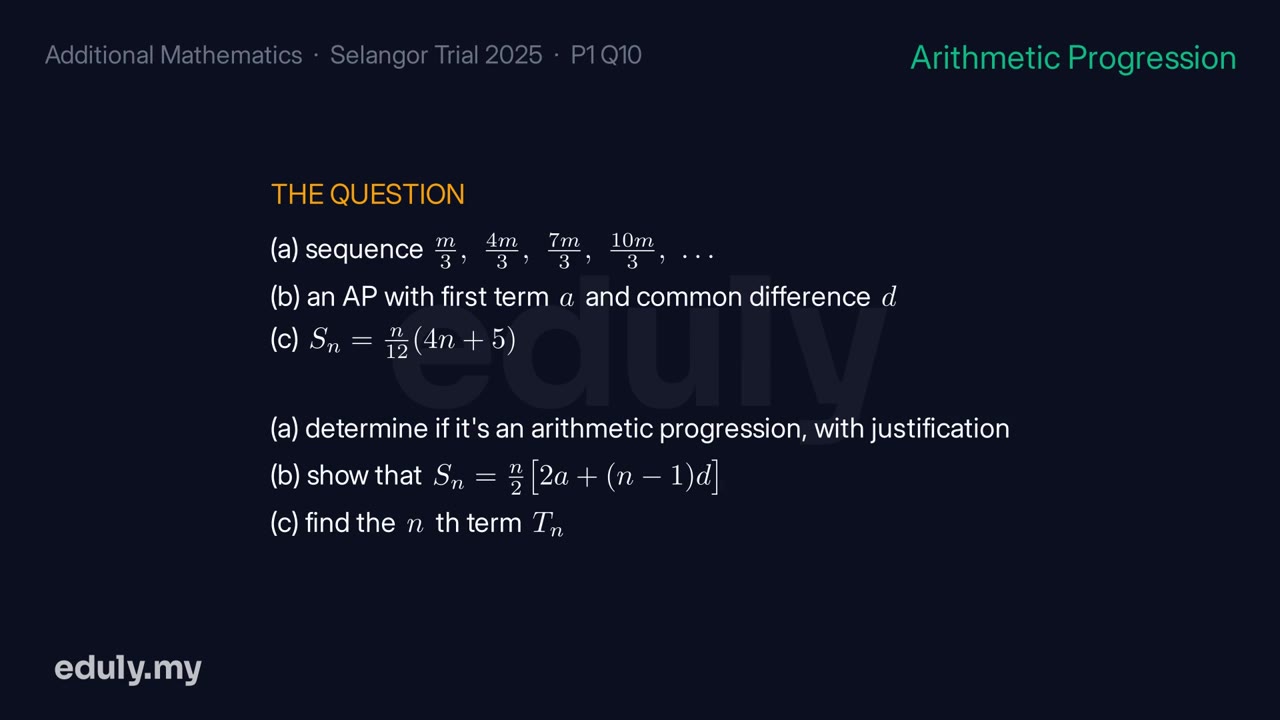
(a) Determine whether the following sequence is an arithmetic progression or not. Give your justification.
m/3, 4m/3, 7m/3, 10m/3, …
(b) If a is the first term and d is the common difference of an arithmetic progression, show that the sum of the first n terms of the progression is Sₙ = (n/2)[2a + (n − 1)d].
(c) It is given that the sum of the first n terms of an arithmetic progression is Sₙ = (n/12)(4n + 5). Find the nth term.
 7:59
7:59Part (a)
Step 1
Test for a constant difference between consecutive terms.
Why this step
An AP means the gap between neighbouring terms never changes, so we subtract each term from the next one and compare the gaps.
4 more steps, each with the reason for it, in the full solution
Final answer
Yes, it is an AP: the difference is always m
Where students lose marks
Watch out: one matching difference isn't enough. Show at least two equal differences, and say the difference is constant.
Part (b)
5 more steps, each with the reason for it, in the full solution
Final answer
Shown: Sₙ = (n/2)[2a + (n − 1)d]
Where students lose marks
Watch out: add the forwards and reversed sums, write the last term as a + (n − 1)d, and finish by dividing by 2.
Part (c)
6 more steps, each with the reason for it, in the full solution
Final answer
Tₙ = (8n + 1)/12
Where students lose marks
Watch out: replacing n by (n − 1) turns 4n + 5 into 4n + 1, and subtracting flips every sign in the bracket.
Watch every step of this question solved on video (7:59), with the reason behind each step and a box that checks your own answer.
No card. Every past-year question on video, in English and BM.
Questions are re-typeset by Eduly for study and commentary. Eduly is not affiliated with Lembaga Peperiksaan Malaysia or the Ministry of Education.