MRSM Trial 2025 Add Maths Paper 2, Question 5Quadratic Functions
Solved on video in English · Form 4, Quadratic Functions · 7:17 video
The question
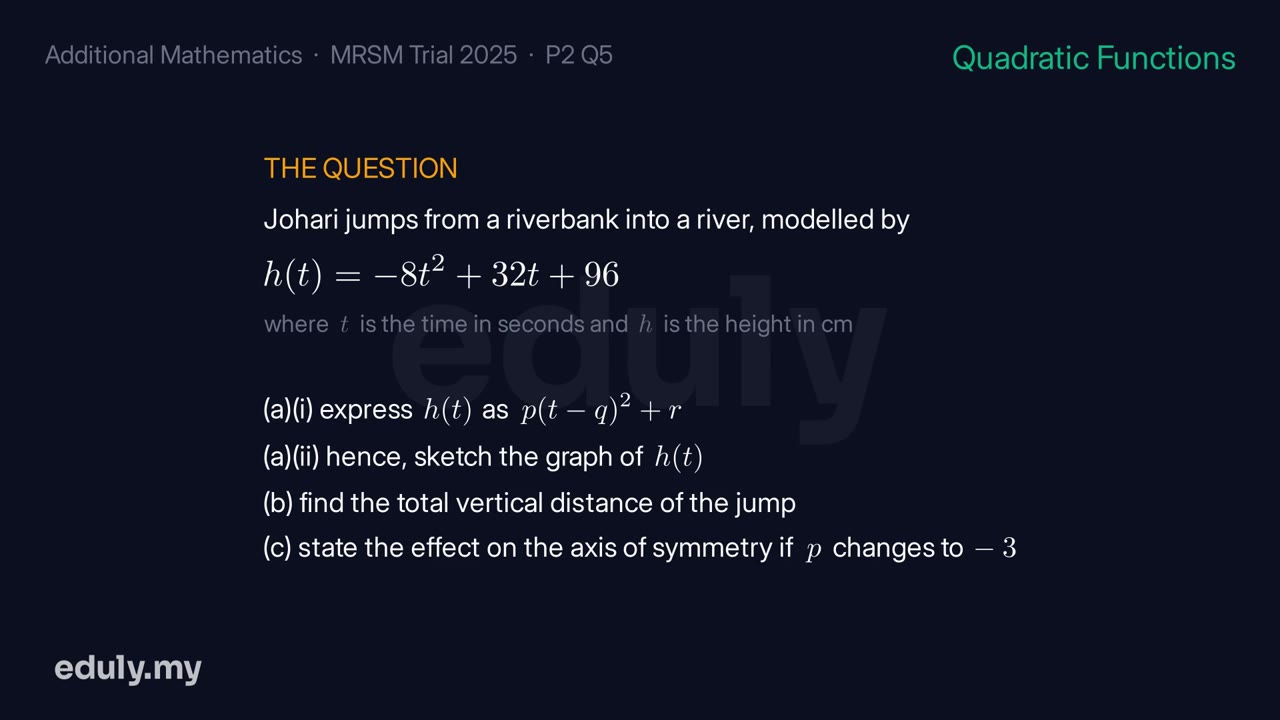
Johari's jump from a riverbank into the river can be represented by the quadratic function h(t) = −8t² + 32t + 96, where t is the time in seconds and h is the height in cm.
(a)(i) By using the completing the square method, express h(t) in the form p(t − q)² + r, where p, q and r are constants.
For h(t) = −8t² + 32t + 96 = −8(t − 2)² + 128:
(a)(ii) Hence, sketch the graph of h(t).
Johari's jump is represented by h(t) = −8t² + 32t + 96 = −8(t − 2)² + 128 (t in seconds, h the height in cm).
(b) Calculate the total vertical distance, in cm, of Johari's jump from the riverbank until he reaches the water surface.
For the quadratic function written as p(t − q)² + r (from h(t) = −8(t − 2)² + 128):
(c) Determine the effect on the equation of the axis of symmetry if the value of the coefficient p changes to −3.
 7:17
7:17Part (a)(i)
Step 1
Factor −8 from the t terms: h(t) = −8(t² − 4t) + 96.
Why this step
Completing the square needs t² to have coefficient 1, so we pull −8 out of the t² and t terms only and leave 96 outside.
2 more steps, each with the reason for it, in the full solution
Final answer
h(t) = −8(t − 2)² + 128
Where students lose marks
Watch out: the −8 outside the bracket also multiplies the −4 left inside, giving +32. Then check you get +128, not −128.
Part (a)(ii)
4 more steps, each with the reason for it, in the full solution
Final answer
Sketch (see video): ∩-shaped, max (2, 128), through (0, 96) and (6, 0)
Where students lose marks
Watch out: p = −8 means a ∩-shaped graph, and always label the maximum point and both intercepts on your sketch.
Part (b)
3 more steps, each with the reason for it, in the full solution
Final answer
160 cm
Where students lose marks
Watch out: count the 32 cm rise from the bank to the peak as well as the 128 cm fall. Don't use only 128, or add 96.
Part (c)
2 more steps, each with the reason for it, in the full solution
Final answer
No change: axis stays t = 2
Where students lose marks
Watch out: p only changes how wide or steep the parabola is. The axis of symmetry t = q does not move.
Watch every step of this question solved on video (7:17), with the reason behind each step and a box that checks your own answer.
No card. Every past-year question on video, in English and BM.
More Quadratic Functions questions
- Kuala Lumpur Trial 2025 Add Maths Paper 1, Question 3
- Kuala Lumpur Trial 2025 Add Maths Paper 2, Question 2
- Melaka Trial 2025 Add Maths Paper 1, Question 2
- Melaka Trial 2025 Add Maths Paper 1, Question 10
- Melaka Trial 2025 Add Maths Paper 2, Question 2
- MRSM Trial 2025 Add Maths Paper 1, Question 7
- Selangor Trial 2025 Add Maths Paper 1, Question 5
- Selangor Trial 2025 Add Maths Paper 2, Question 4
Questions are re-typeset by Eduly for study and commentary. Eduly is not affiliated with Lembaga Peperiksaan Malaysia or the Ministry of Education.